Solo, Duo or Ensemble Recording: What Changes in the Sound?
Solo, duo or ensemble recording changes how musical details meet. Learn which format suits a song’s intimacy, conversation or layered energy.
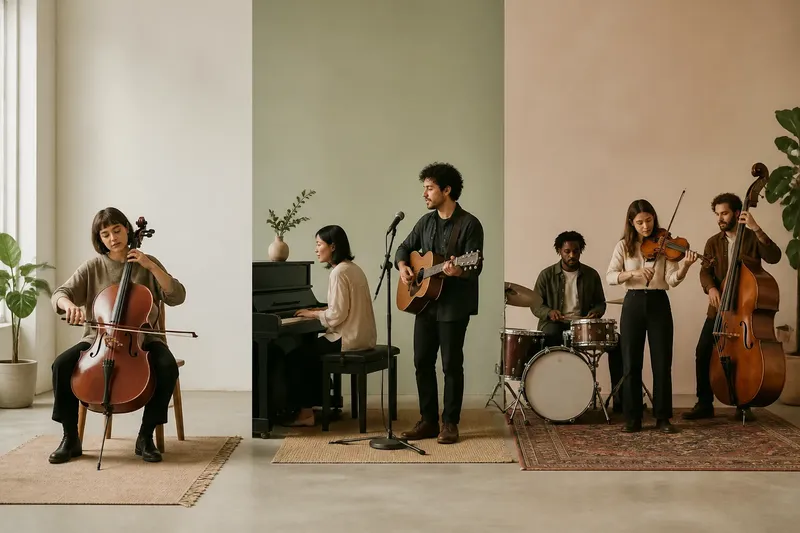
The most common mistake when choosing a recording format is treating more performers as a simple upgrade. A solo recording can put every pause and breath close to the listener; add another musician and those details become part of a conversation. A larger ensemble changes the sound again, making the relationships between parts as important as the parts themselves.
Solo, duo or ensemble recording is best chosen by asking what the listener should notice first: one person shaping a phrase, two musicians responding to each other, or several parts creating a shared texture. None is inherently fuller or more expressive. The useful choice is the one that lets the music’s main relationship come through.
What should the listener hear first?
Start with the song or performance in its simplest audible form. Listen for its centre of attention. Is the appeal in a single voice or instrument changing colour, in two parts leaning towards and away from each other, or in a layered sound whose character depends on several contributions?
This is not a test of how many notes are being played. A solo pianist may create a dense texture, while a group may leave generous space. Count the distinct musical roles instead: who carries the main line, who answers it, and what creates the surrounding atmosphere?
If one performer already provides all those roles convincingly, recording alone may preserve the clearest focus. If an answer or counterline feels essential, a second player can make that exchange audible. If the sound relies on several independent layers, an ensemble may be the natural fit.
When does a solo recording fit?
Choose a solo format when the listener should stay close to one performer’s decisions. A singer with acoustic guitar, a solo cello, or a pianist playing a flexible arrangement can make tiny changes in timing and intensity feel central. There is little competition for attention, so the performance’s shape is easy to follow.
That closeness also exposes the spaces between gestures. A held note, a breath before the next line, or a small change in touch may carry as much character as a louder passage. The sound need not be sparse; the point is that one musical perspective remains in charge.
Solo recording suits a piece whose emotional movement comes from sustained attention to one voice or instrument. It can also suit an arrangement that depends on a performer shaping several layers alone, as long as the listener can still hear how those layers relate.
The trade-off is that musical exchanges have to be suggested by the soloist’s phrasing or arrangement. If a song’s character depends on a distinct response from another player, a solo performance may make that response feel imagined rather than shared. That can be a deliberate effect, but it changes the social feel of the music.
When does a duo make the music feel conversational?
A duo fits when two parts need to affect each other in real time. Voice and piano, fiddle and guitar, or two voices can create a clear exchange: one introduces an idea, the other colours, answers or gently resists it. The listener can follow both musicians without the conversation becoming crowded.
The defining sound is not simply “two instruments”. It is the relationship. A backing part might follow the lead closely, while another arrangement gives each musician room to propose new shapes. Even a steady accompaniment can change how a phrase lands by altering its emphasis or leaving a gap at the right moment.
A duo can be especially apt when a song needs support but not a continuous bed of sound. It offers more contrast than a solo performance while keeping the musical picture relatively open. The balance between the players becomes part of the expression, rather than a background detail.
Imagine a songwriter whose verses feel compelling with voice and guitar, but whose chorus needs a second voice to answer the last line. Keeping the verses solo and bringing in the second singer for those replies would make the arrangement’s change in intimacy easy to hear. The expected result is a shift from solitary address to audible exchange, without filling every moment with another part.
When does an ensemble create the right texture?
An ensemble fits when the music’s identity depends on several distinct contributions. A rhythm section, backing voices and a melodic instrument might each add a different kind of movement. Together they can create a texture that no single part could suggest on its own.
Listen for whether those roles need to overlap, contrast or move independently. Interlocking rhythms can make a performance feel buoyant; sustained tones beneath a moving melody can widen its sense of space; several voices can turn a single line into a communal sound. The ensemble is doing more than adding volume when its parts shape the music in different ways.
A larger group can also shift the listener’s attention away from one performer. A lead voice may remain prominent, but the surrounding parts become an active setting rather than mere support. This suits music where collective movement, changing density or the interplay of sections is central.
The trade-off is that individual gestures may be less exposed. A quiet inflection can become one colour among many, and a simple phrase may feel less intimate once several parts surround it. If those close details are the heart of the performance, a full arrangement could distract from them.
How do you choose a recording format?
Use these questions to sort the music by the listening experience it needs, rather than by a preferred level of production:
- Is one performer’s phrasing the main event? Consider solo recording, so breaths, timing and changes in touch stay in the foreground.
- Does the music need a distinct reply or counterline? Consider a duo, where the exchange can remain clear and personal.
- Do several parts have separate musical jobs? Consider an ensemble if those roles need to be heard together.
- Should the sound feel private or shared? A solo performance often gives one perspective particular closeness; a group can make the performance feel collectively shaped.
- Does the arrangement need to move between different textures? A duo or ensemble may allow a part to enter, withdraw or change the overall density at a meaningful point.
- Would another part answer a question the music actually asks? Add a player when the exchange contributes meaning, not merely because the arrangement seems empty.
These are listening prompts, not rules. A song can begin with a solo voice and open into an ensemble, or use a duo throughout while allowing the musicians’ roles to change. The format can describe the whole performance or the way its texture develops.
What questions help settle the choice?
Does a solo recording have to sound sparse?
No. One performer can create a rich arrangement through chords, sustained notes, rhythmic detail or changes in register. What makes it solo is the source of the performance, not how few layers the listener hears.
Is a duo simply a smaller ensemble?
It can be described that way, but the listening effect is often more specific: two parts are easy to track as a direct exchange. If the music depends on several overlapping roles, a larger group may make those relationships clearer.
Can an ensemble still feel intimate?
Yes. Intimacy can come from restrained playing, close interaction or a texture that leaves room around the lead. The number of performers alone does not decide how near the music feels.
Can a recording move between solo, duo and ensemble textures?
Yes, if each change supports the music’s shape. A part might enter to answer a line or deepen a later passage, giving the listener a noticeable change in relationship and texture rather than an arbitrary increase in sound.
What should the final choice preserve?
Before settling on solo, duo or ensemble recording, name the detail you would most miss if it disappeared: a solitary phrase, a musical reply, or the way several parts combine. Then choose the format that keeps that detail legible. The right decision is less about how many people are in the room than about what the listener gets to hear between them.
When a song seems to ask for more players, try describing the missing sound in ordinary terms: an answer, a pulse, a sustained background, or a group of voices. That description can reveal whether the music needs a second perspective or a broader ensemble, and it keeps the arrangement’s purpose audible from the first phrase to the last.