Before the Studio Album: Songs Learned by Ear
Songs learned by ear carry memory through voices, rooms and changing details; learn how to hear variation as part of a living musical tradition.
The common mistake with songs learned by ear is to treat every difference as a mistake to correct. That can cost a tradition some of its character: a tune passed between relatives, neighbours or fellow musicians is not always a fixed object, but a practice shaped by who sings it and where.
In many settings where songs were shared orally, a singer learned from another person rather than from a single definitive recording. The learner became both a source and a listener, carrying the tune onward in a particular form. This was not the only way songs travelled, but it helps explain why versions can differ.
What does a singer actually pass on?
A song learned by ear arrives as more than a sequence of pitches and words. The learner takes in phrasing, breath, emphasis, pace and the circumstances in which the song is sung. A lullaby whispered at bedtime may be remembered differently from a work song kept in time with a shared task, even if both are called by the same name.
Memory does not behave like a recording device. A person may retain the shape of a melody while changing a word, lengthening a note or shifting the place where a breath falls. Those choices can become part of the version that person later teaches.
It helps to notice what seems stable as well as what changes. A refrain may remain recognisable while verses vary; a rhythmic pattern may hold together a melody whose exact notes differ from singer to singer. Listening for these anchors gives you a better sense of how the song continues to be itself.
Why can two versions both belong?
Oral transmission has no single master copy unless a community chooses to treat one as authoritative. Different households, regions or groups of performers may carry distinct verses or melodic turns. That does not automatically make one version more genuine than another.
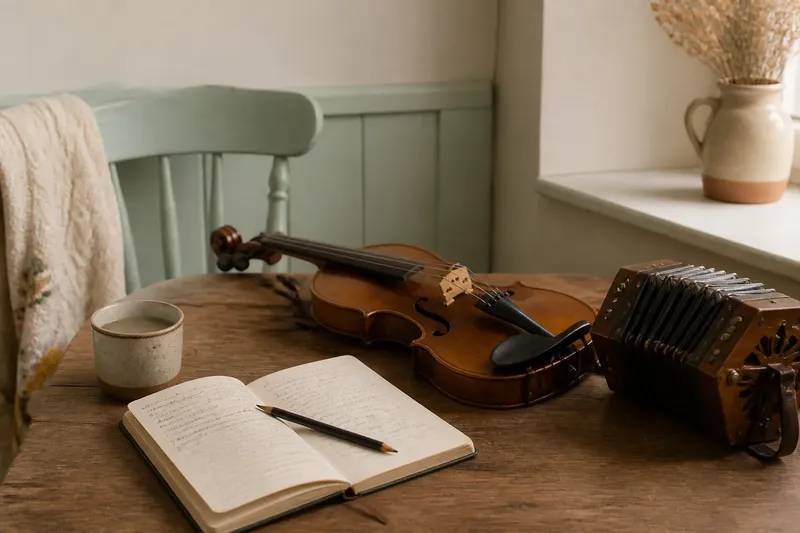
Variation can reflect practical choices. A singer might adjust a line to fit the breath, make a verse easier for a group to join, or use a local word that listeners understand. A tune may also shift as it moves between musical settings: a melody sung unaccompanied can be phrased differently from one played with a fiddle or concertina.
Imagine a learner who hears a family song at a kitchen table, then sings it with cousins at a gathering. One cousin remembers a different final line, and the group keeps that line because it fits the story they have been told. The resulting version may preserve the family connection while carrying a detail that belongs especially to that gathering.
That does not mean every difference is unimportant. A changed word may alter a song’s meaning, and a new verse may reflect a particular person’s experience. The useful question is not simply, “Which version is correct?” Ask what each version retains, what it changes and who recognises it as theirs.
How can you listen for variation?
When you hear more than one rendition, resist the urge to compare them only against a supposed original. Listen for the places where singers make choices. You might notice that one voice clips a phrase, another stretches its ending, or a chorus changes from a solo response into a group refrain.
- Follow the contour. If the melody rises and falls in a similar broad shape despite note changes, treat that contour as a shared anchor; if the shape differs substantially, note that the singers may be carrying distinct melodic versions.
- Listen for the refrain. If its words or rhythm recur, use them to identify a shared feature; if the response changes, record the difference rather than silently substituting one version for another.
- Notice the breathing. If a singer pauses in the same place, mark that phrasing; if pauses fall differently, consider how the line’s emphasis or meaning shifts.
- Compare the words. If the difference is pronunciation or local vocabulary, write down the form you hear; if whole verses differ, keep them as separate variants and ask about their source where appropriate.
- Attend to the setting. If the song is sung alone, note its solo phrasing; if a group or instrument is involved, listen for changes in pace, response and emphasis before treating them as part of the tune itself.
- Check what the singer says about use. If they describe a particular family, community or ceremonial context, respect that boundary; if they are comfortable with wider sharing, clarify what form of sharing they mean.
These observations are useful even when you know little about the song’s background. They keep listening grounded in what you can hear rather than in assumptions about what a tradition ought to sound like.
How do you learn a song without flattening it?
Start with a person who knows the song, if that is possible, and ask them to sing it at a comfortable pace. Listen through once before trying to join in. Then learn a short phrase, sing it back, and let the singer correct what they think matters.
Pay attention to delivery as well as notes. A word may fall slightly behind the beat, or a phrase may gather speed towards its end. If you learn only the tune’s outline, you may miss the feel that makes this singer’s version distinctive.
A phone recording can help you remember a version, but ask before recording and be clear about how you intend to use it. A private reference is different from posting a performance online. Some songs are closely tied to family, community or ceremonial contexts, and a singer may not want them circulated beyond those settings.
If there is no one available to teach you, compare recordings from different singers rather than treating one as the final authority. Write down what you hear, including uncertain words and places where versions diverge. Marking uncertainty is more honest than silently replacing a detail with the one that seems most familiar.
What questions help you understand a song’s path?
Who taught the singer this version?
A singer may name a relative, friend, teacher or community gathering. That answer gives you a starting point for understanding how the song travelled, not necessarily a complete account of its origins.
Which parts stay recognisable across versions?
Look for recurring phrases, melodic shapes, rhythms or responses. These shared features can show how a song holds together while allowing different singers room to shape it.
Why might a word or verse have changed?
It could reflect local speech, a remembered story, a singer’s preference or a listener’s mishearing. Ask the person who taught you, if appropriate, and keep the answer distinct from what you can verify by listening.
Is this song meant for every setting?
Some songs move freely between social settings; others have a particular purpose or context. Find out how the people who carry the song understand its use before performing or sharing it elsewhere.
How should you preserve what you learn?
Preservation need not mean making one version permanent. Keep the singer’s name, the place you heard the song and any context they are comfortable sharing. Those details help future listeners understand that a version came through a particular person rather than appearing from nowhere.
If you write down lyrics, distinguish words you are sure of from those you are guessing. Note pauses, repeated lines and alternative verses in the margins. A plain notebook can preserve these useful details without pretending to capture every shade of a live voice.
When teaching the song onward, say where you learned it and whether you have changed anything. You can invite a learner to keep the version close to yours, or to make choices of their own; either way, make the relationship between versions clear.
Songs learned by ear are carried through attention, memory and human contact. When listening to songs learned by ear, let differences point towards the singers and settings behind them, while treating each person’s account with care. A tradition remains audible not only in what stays the same, but in the voices that keep finding a way to sing it.